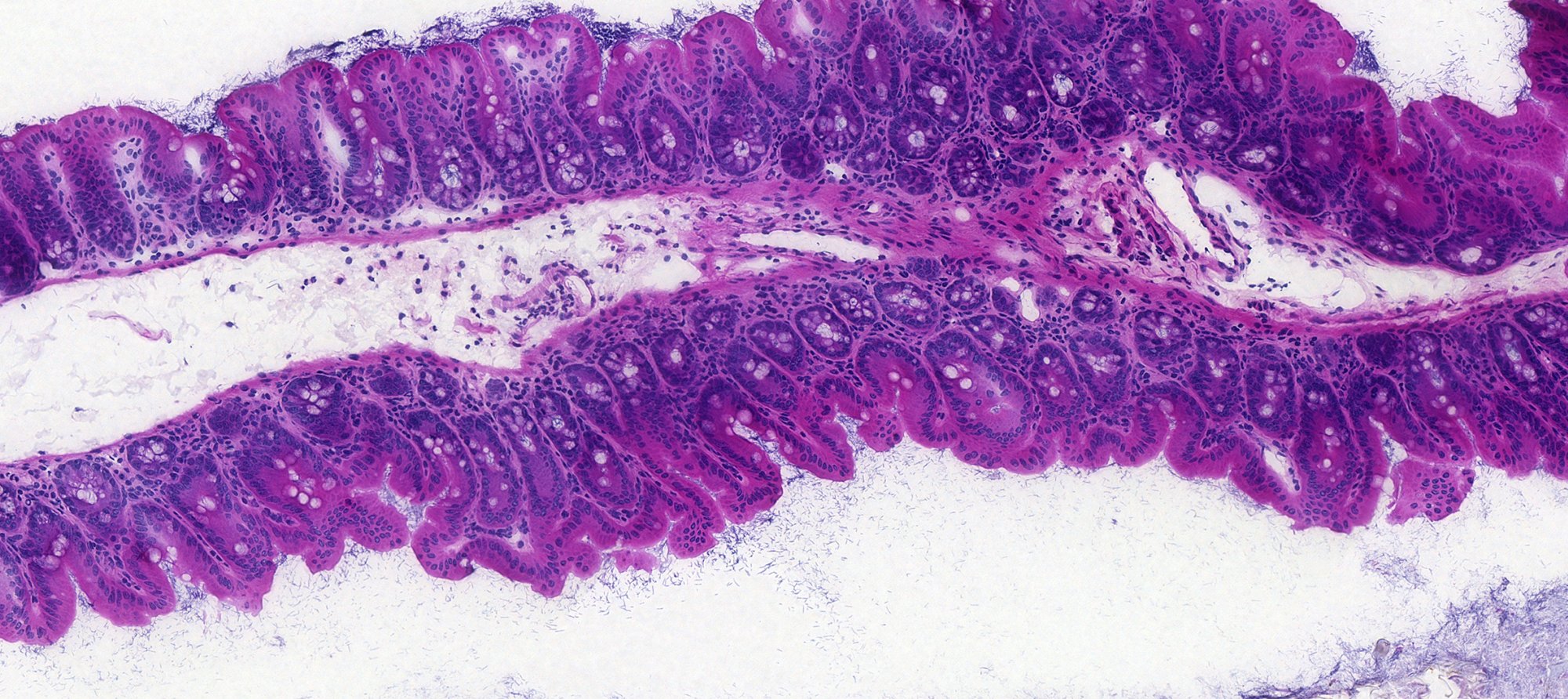
H&E-stained section of intestinal mucosa.
Team – Slack Group

Emma Slack
Faculty Member / Principal Investigator


Niina Ruoho
Senior Technical Expert


Noemie Allet
PhD Student
Projects/Publications
2026 - Miravet-Verde S, Cacace E, Mores CR, et al.
In silico typing maps the natural diversity of Escherichia coli transporter-dependent capsules. Nat Microbiol. 2026;11(5):1217-1232. doi:10.1038/s41564-026-02323-5
Publication
Publication
→
2025 - Arnoldini M, Sharma R, Moresi C, et al.
Quantifying the varying harvest of fermentation products from the human gut microbiota.
Publication
Publication
→
2025 - Bilgin, Mehmet Berk, et al.
"Microbial and antimicrobial resistance diagnostics by gas sensors and machine learning." Cell Biomaterials (2025).
Publication
Publication
→
2025 - Verena Lentsch et al.
Vaccine-enhanced competition permits rational bacterial strain replacement in the gut (2025).
Publication
Publication
→
2024 - Jacob Wilde et al.
Host control of the microbiome: Mechanisms, evolution, and disease (2024).
Publication
Publication
→
2024 - Cappio Barazzone, E., Diard, M., Hug, I., Larsson, L., & Slack, E.
Diagnosing and engineering gut microbiomes. EMBO molecular medicine, 16(11), 2660–2677.
Publication
Publication
→
2023 - Lan, Jiayi, et al.
"Non-invasive monitoring of microbiota and host metabolism using secondary electrospray ionization-mass spectrometry." Cell Reports Methods 3.8 (2023).
Publication
Publication
→
2023 - Hockenberry, A., Slack, E., & Stadtmueller, B. M.
License to clump: secretory IgA structure–function relationships across scales. Annual review of microbiology, 77(1), 645-668.
Publication
Publication
→
2022 - Slack, E., & Diard, M.
Resistance is futile? Mucosal immune mechanisms in the context of microbial ecology and evolution. Mucosal immunology, 15(6), 1188–1198.
Publication
Publication
→


