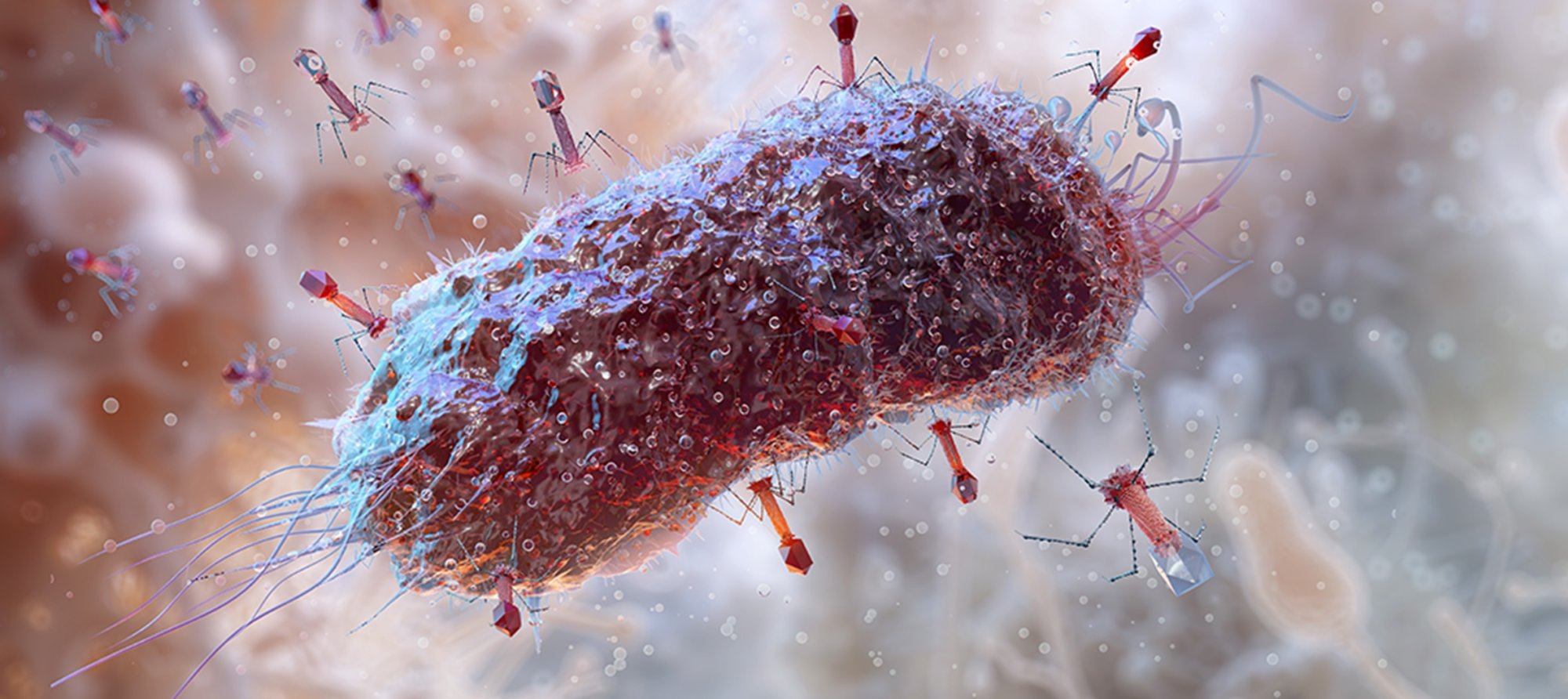
Multiple Bacteriophages attacking a bacterial cell.
Team – Beisel Group

Chase Beisel
Faculty Member / Principal Investigator



BingBing Yu
Postdoc


Maximilian Feußner
Bioinformatics Postdoc






Xiye Chen
PhD Student

Noemie Allet
PhD Student
Projects/Publications
2026 - Scholz, P., Thompson, J., Crosby, K.T. et al.
RNA-triggered cell killing with CRISPR–Cas12a2. Nature (2026). https://doi.org/10.1038/s41586-026-10466-y
Publication
Publication
→
2026 - Migur A, Feussner M, Liao C, et al.
A leader-repeat hairpin blocks extraneous CRISPR RNA production in diverse CRISPR-Cas13 systems. EMBO J. 2026;45(10):3396-3415. doi:10.1038/s44318-026-00769-1
Publication
Publication
→
2025 - Dmytrenko, Oleg, et al.
"RNA-triggered Cas12a3 cleaves tRNA tails to execute bacterial immunity" Nature (in press).
2025 - Gupta, Darshana, et al.
"Targeted DNA ADP-ribosylation triggers templated repair in bacteria and base mutagenesis in eukaryotes." Nature Biotechnology (in press).
Publication
Publication
→
2023 - Jiao, Chunlei, et al.
"RNA recording in single bacterial cells using reprogrammed tracrRNAs." Nature biotechnology 41.8 (2023): 1107-1116.
Publication
Publication
→
2023 - Dmytrenko, Oleg, et al.
"Cas12a2 elicits abortive infection through RNA-triggered destruction of dsDNA." Nature 613.7944 (2023): 588-594.
Publication
Publication
→
2022 - Liao, Chunyu, et al.
"Spacer prioritization in CRISPR–Cas9 immunity is enabled by the leader RNA." Nature Microbiology 7.4 (2022): 530-541.
Publication
Publication
→
2021 - Jiao, Chunlei, et al.
"Noncanonical crRNAs derived from host transcripts enable multiplexable RNA detection by Cas9." Science 372.6545 (2021): 941-948.
Publication
Publication
→


