DeepIR – Deep learning for Immune Receptor specificity modeling

The DeepIR Flagship Program (Deep learning for Immune Receptor specificity modeling) is a pioneering research initiative at the Botnar Institute of Immune Engineering that combines cutting-edge experimental biology with advanced computational modeling. Our mission is to decode how immune receptors (antibodies and T cell receptors) recognize and interact with their targets, a fundamental challenge in immunology and therapeutic discovery.

By integrating high-throughput data generation with state-of-the-art deep learning approaches, DeepIR aims to build predictive models of immune recognition that can accelerate the discovery of new therapeutics and diagnostics. The program brings together a multidisciplinary team of experimentalists, automation specialists, computational biologists, and machine learning experts to create scalable frameworks for immune receptor design and specificity prediction. Through these efforts, DeepIR seeks to advance both basic science and translational applications, from understanding immune defense mechanisms to engineering next-generation immunotherapies accessible to patients worldwide.

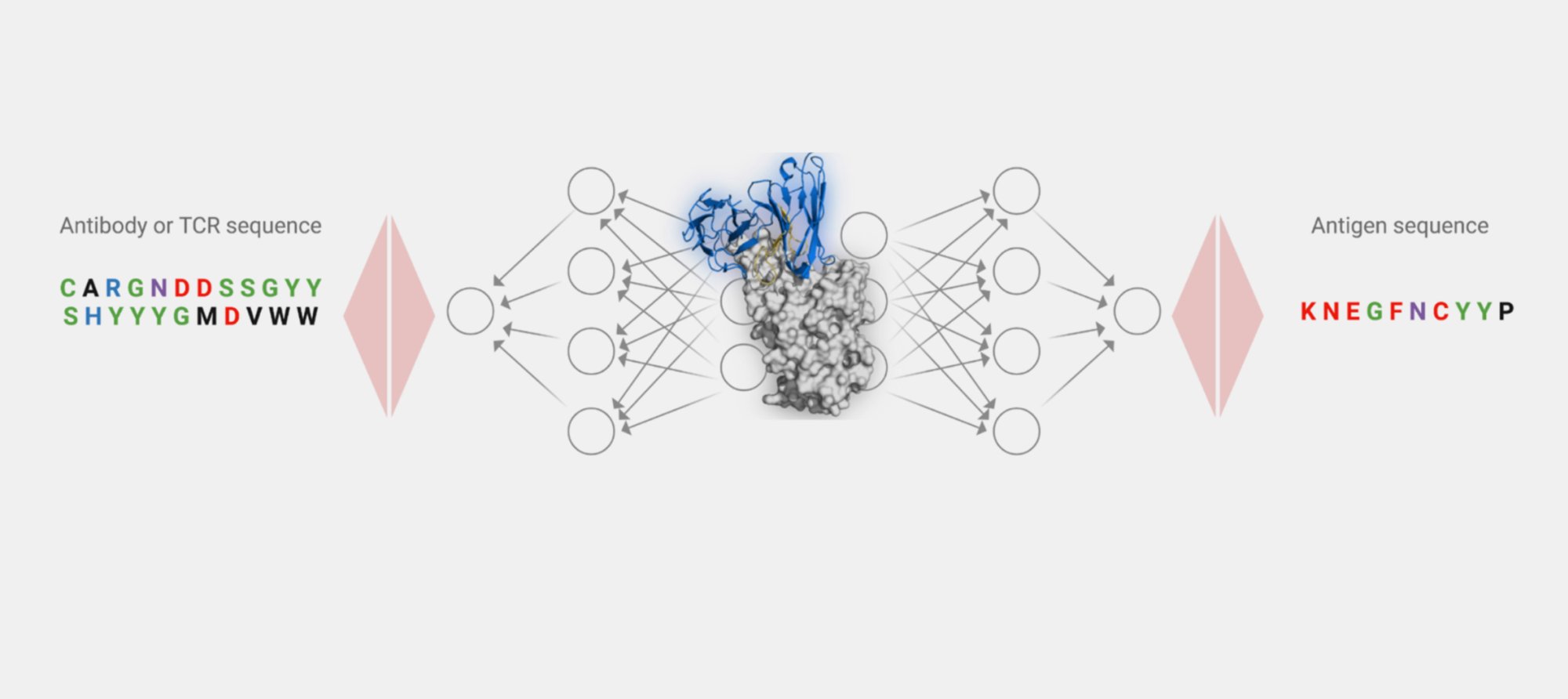
Deepl learning model for predicting TCR-antigen interactions
Deep learning for bidirectional prediction of antibody-antigen or TCR-pMHC interactions.

Research Focus

DeepIR develops and applies innovative platforms, workflows, and strategies at the intersection of immune engineering, data science, and artificial intelligence.

Our focus areas include:

High-throughput immune receptor discovery and characterization:

  • Generating large, diverse datasets of antibody and TCR sequences and their antigen specificities (paratope-eptiope interactions).

Protein language models and structure-based AI:

  • Leveraging cutting-edge machine learning to predict receptor–antigen interactions from sequence and structural information.

Integration of experimental and computational pipelines:

  • Designing closed feedback loops where experimental data inform models, and models guide new experimental discovery.

Therapeutic translation:

  • Applying predictive models to accelerate the development of antibodies and TCR-based therapies for infectious diseases, oncology, and immune disorders.

Together, these research directions aim to transform immune receptor discovery from trial-and-error screening into a rational, data-driven, and globally impactful process.

Team – DeepIR

Derek Mason

Derek Mason

Project Director / Director of Research Operations

Verena Schäfer

Verena Schäfer

Lab Manager
Experimental Group

Byeongseon Yang

Byeongseon Yang

Senior Scientist
Experimental Group

Yin-Hsi Lin

Yin-Hsi Lin

Scientist
Experimental Group

Bastian Wagner

Bastian Wagner

Scientist
Experimental Group

Sarah Bendahhou

Sarah Bendahhou

Research Associate
Experimental Group

Luca Witte

Luca Witte

Research Associate
Experimental Group

Maria Chatzinikolaou

Maria Chatzinikolaou

Research Associate
Experimental Group

Ruth Esser

Ruth Esser

Research Associate
Experimental Group

Andreas Scheck

Andreas Scheck

Lead Computational Scientist
Computational Group

Karla Castro

Karla Castro

Computational Scientist
Computational Group

Hyunho Lee

Hyunho Lee

Computational Scientist
Computational Group

Sean Renwick

Sean Renwick

Data Science Associate
Computational Group